We live in a culture obsessed with "the next big discovery." Whether it is a new archeological dig or a freshly unearthed ancient fragment, we are conditioned to believe that newer is always truer. Unfortunately, this mindset has deeply infected how we view the Bible. Modern textual criticism often treats the scriptures like a crime scene, operating under the assumption that the true Word of God was somehow lost or buried in the sands of Egypt for thousands of years, waiting for modern academics to dig it up and fix it.
But Scripture itself presents a completely different reality. It gives us the Doctrine of Preservation—the beautiful, comforting promise that God will actively protect and maintain His Word for every generation.
If this doctrine is true—and both scripture and history prove that it is—then the modern concept of relying on a "newly discovered" ancient manuscript to rewrite our Bibles is not a triumph of science. It is a theological absurdity.
The Scriptural Promise of Preservation
God did not inspire His Word only to let it evaporate or become corrupted by human hands. Throughout the Old and New Testaments, God explicitly promises that His words are permanent:
"The grass withereth, the flower fadeth: but the word of our God shall stand for ever." — Isaiah 40:8
"For verily I say unto you, Till heaven and earth pass, one jot or one tittle shall in no wise pass from the law, till all be fulfilled." — Matthew 5:18
"Heaven and earth shall pass away, but my words shall not pass away." — Matthew 24:35
Preservation is an attribute of God's faithfulness. If God promised to keep His words available to His people, then the history of the Bible is not a story of human evolutionary accident, but of divine, historical oversight.
The Instrument of Preservation: The Living Church
God did not preserve His Word by hiding it in a cave or locking it in a time capsule. He used His people. God entrusted the keeping of His words to a continuous, living line of believers who read, copied, and breathed these texts in public worship.
1. The Fearful Precision of the Scribes
Long before the printing press, God used human hands to multiply His Word, inspiring a culture of unmatched reverence among copyists:
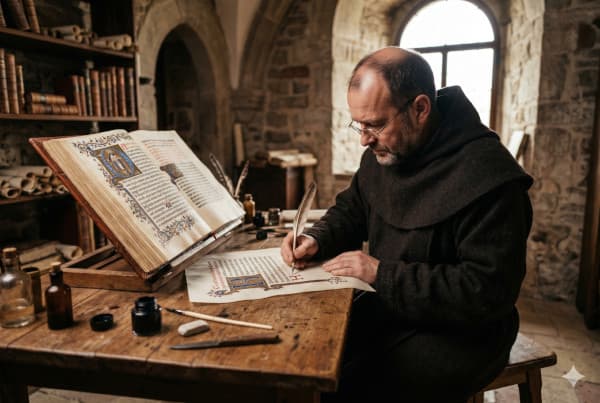
- Hebrew Scribes (The Masoretes): Jewish scribes treated the Old Testament with terrifying precision. They counted every single letter, word, and line of a manuscript. If a completed scroll had a single mistake, or if the middle letter of the scroll didn't match the master copy, the entire scroll was destroyed.
- Christian Scribes: Early Christians faced persecution and death to copy the New Testament. They didn't view copying as an academic exercise, but as a holy duty. They prioritized accuracy because they knew they were handling the very words of life.
2. The Respect for Ecclesiastical Usage: The Peshitta and Vulgate
When the early Church grew, it needed standard translations for public worship. This is where the Syriac Peshitta (in the East) and Jerome’s Latin Vulgate (in the West) shine.
- The bishops and translators who structured these versions had a profound respect for ecclesiastical usage. They didn't go looking for the strangest, most obscure readings. They looked at what the churches were actually reading in public liturgy.
- Once these texts were recognized by the Church as faithful, they became "frozen artifacts." Even when major theological splits divided the Middle Eastern churches in the 5th century, both sides fiercely protected the exact same Peshitta text. The Church kept the text safe from human tampering.
3. The Textus Receptus (The Received Text)
Centuries later, when the printing press was invented, Western scholars compiled the Greek manuscripts that had been preserved for over a millennium by the Eastern (Byzantine) Church. This became known as the Textus Receptus—the "Received Text." The name itself tells the story: it was the text received and acknowledged by generations of faithful believers. It was this historically preserved stream that gave birth to the King James Version.
The Absurdity of the "Undiscovered Manuscript"
This brings us to the ultimate clash between the Doctrine of Preservation and modern textual criticism.
Modern translations like the ESV or NIV rely heavily on a tiny handful of Egyptian manuscripts (like Codex Sinaiticus and Codex Vaticanus) that were rediscovered in monasteries and trash heaps in the 19th century. Because these manuscripts are physically older, modern critics claim they are better—even though they contain thousands of missing words, sentences, and historical blunders.
Think about the logical conclusion of that premise: If modern textual criticism is right, then the Doctrine of Preservation is a lie. If the truest version of the New Testament was sitting unused in an Egyptian monastery for 1,500 years, it means that for fifteen centuries, the martyrs who died for the faith, the reformers who preached the gospel, and the millions of believers who walked with God did not have the true Word of God. It implies that God broke His promise to preserve His Word for every generation, leaving it lost until a few modern academics dug it up in the 1800s.
As believers, we reject that concept. God’s Word is not an archaeological mystery waiting to be solved. It is a living inheritance that has been passed from Christ, to the Apostles, through the scribes, into the local church, and straight onto our laps today.
Conclusion: Trusting the Process of God
When we understand the Doctrine of Preservation, it gives us immense peace. We don't have to worry that a new archaeological discovery tomorrow might change what we believe about Jesus. We don't have to look at modern translation footnotes with anxiety.
God has been faithful. He used the meticulous care of Hebrew scribes, the liturgical wisdom of the early Church fathers, and the global network of believers to ensure that the Bible you hold today is the exact same Word He spoke into existence. We can read our Bibles not with academic skepticism, but with absolute providential confidence.